
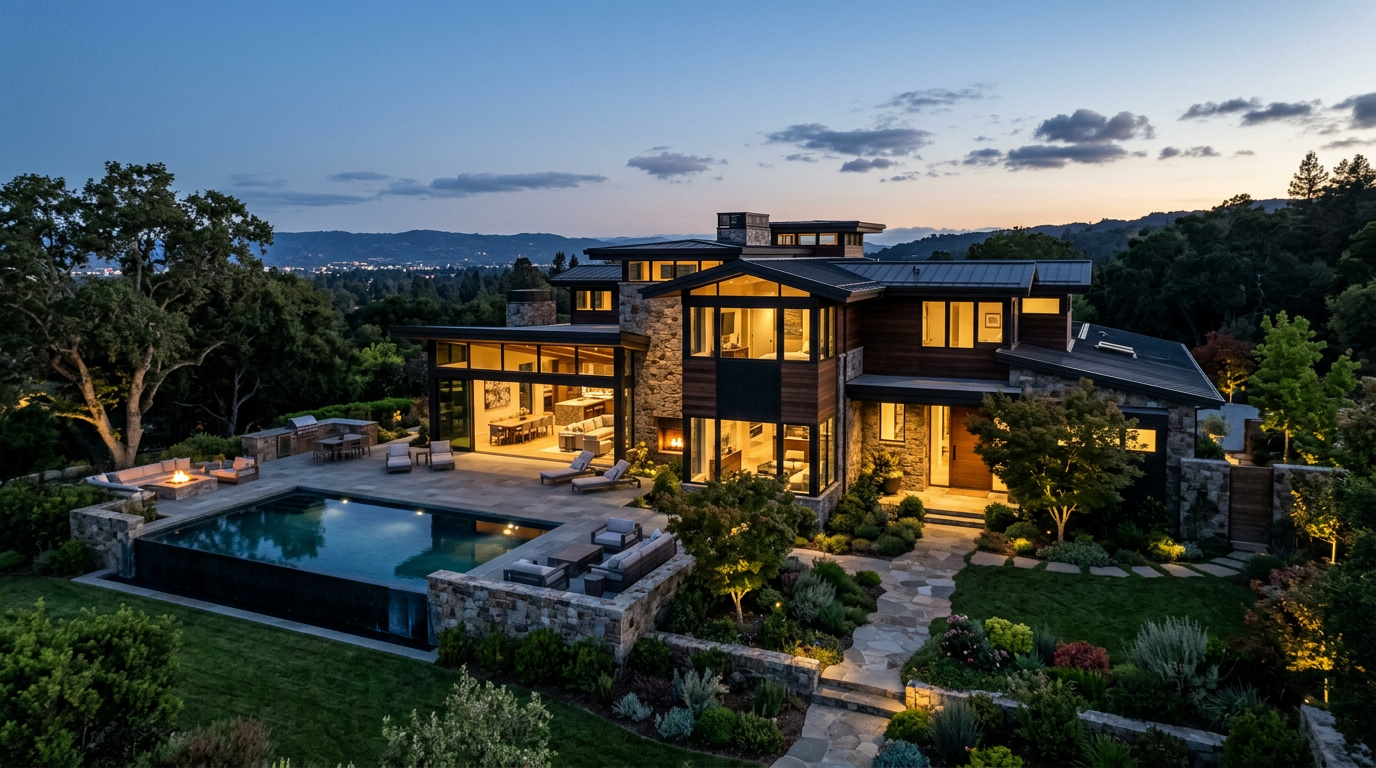
When the real estate market shifts, not all luxury homes respond in the same way.
Some properties experience significant price reductions or extended marketing periods. Others continue to attract serious buyers, even when overall market activity slows.
What explains the difference?
In Silicon Valley, where luxury properties can represent substantial financial investments, understanding what supports a home’s value during a market correction is particularly important.
The answer isn’t simply price, size, or the number of high-end amenities. It’s the combination of qualities that make a property desirable when buyers have more choices and become increasingly selective.
1. Location Remains the Foundation of Value
Location is one of the few characteristics of a property that cannot be changed.
In communities such as Los Gatos, Saratoga, and Monte Sereno, buyers often evaluate more than the address itself.
Privacy, neighborhood character, proximity to employment centers and amenities, views, and the quality of the surrounding environment can all influence desirability.
Even within the same neighborhood, two properties may perform differently.
A home on a quiet street with an appealing setting may attract a different level of interest than a similarly priced property affected by traffic, noise, or other location-related limitations.
During a correction, these distinctions can become more apparent.
2. Scarcity Can Support Demand
Luxury real estate is often defined by features that are difficult to reproduce.
An exceptional parcel, a private setting, distinctive architecture, or an unusually desirable combination of location and amenities may set a property apart from competing listings.
When inventory increases, buyers gain alternatives.
Properties that offer something genuinely difficult to replicate may continue to stand out.
But scarcity must be accompanied by demand.
A feature isn’t necessarily valuable simply because it’s rare. Buyers must also consider it desirable.
A highly unconventional floor plan, for example, may be unusual without appealing to a broad enough buyer pool.
3. Architectural Quality Has Lasting Appeal
Trendy finishes can create excitement, but strong architectural fundamentals often have more enduring relevance.
Thoughtful proportions, natural light, functional layouts, quality construction, and a harmonious relationship between indoor and outdoor spaces can contribute to a home’s long-term appeal.
A well-designed residence may remain attractive even as decorating preferences change.
This is particularly important in Silicon Valley, where buyers encounter everything from historic Craftsman homes to mid-century modern residences and contemporary estates.
Architectural integrity can distinguish a property from homes that rely primarily on expensive finishes.
However, architectural significance alone does not guarantee protection from declining market values.
4. Usable Land Can Be a Competitive Advantage
For many luxury buyers, the property surrounding the home is as important as the residence itself.
Generous outdoor living areas, mature landscaping, privacy, and attractive views can contribute to a property’s appeal.
In markets where desirable parcels are limited, these characteristics may be difficult to duplicate.
But acreage alone isn’t enough.
A level, usable lot may offer greater practical appeal than a much larger parcel affected by steep slopes, access limitations, or significant development restrictions.
During a market correction, buyers may place even greater emphasis on the quality and utility of the land.
5. Condition Matters More When Buyers Have Choices
In a highly competitive market, some buyers may overlook imperfections to secure a property.
That willingness can diminish when inventory rises.
Deferred maintenance, aging systems, roof concerns, drainage problems, or extensive renovation needs may become more significant negotiating factors.
Luxury buyers may be particularly sensitive to the time, cost, and uncertainty associated with major improvements.
A well-maintained home with documented upgrades and a clear understanding of its condition may be easier for buyers to evaluate.
Exceptional presentation attracts attention, but underlying property condition helps support buyer confidence.
6. Functional Design Can Outlast Trends
A spectacular home isn’t necessarily an easy home to live in.
Highly specialized rooms, impractical layouts, or unusually personalized design choices can limit appeal.
By contrast, well-proportioned living spaces, thoughtful storage, comfortable bedroom arrangements, and seamless indoor-outdoor connections can contribute to everyday functionality.
Homes that balance architectural character with livability may appeal to a wider range of buyers.
That broader appeal can be especially useful when fewer purchasers are actively searching.
7. Realistic Pricing Becomes Essential
Even an exceptional luxury property can struggle if its asking price isn’t supported by market conditions.
During a correction, buyers may become more cautious and negotiations more deliberate.
Aspirational pricing can lead to extended days on market, repeated price reductions, and questions about why a property hasn’t sold.
Pricing should reflect recent comparable transactions, current competition, property-specific characteristics, and prevailing buyer behavior.
For architecturally distinctive homes, determining value may require particularly careful analysis because truly comparable properties can be limited.
The strongest property characteristics cannot compensate indefinitely for unrealistic pricing.
8. The Buyer Pool Matters
Luxury real estate doesn’t operate as one uniform market.
A $3 million home in Los Gatos may attract a different buyer pool than a substantially more expensive estate in Monte Sereno.
Financing needs, liquidity, lifestyle priorities, and sensitivity to economic conditions can vary considerably.
Silicon Valley buyers may also have wealth tied to company stock, equity compensation, or privately held businesses.
Changes in financial markets can influence purchasing decisions, even among affluent households.
Understanding who is most likely to purchase a particular property is essential when evaluating its market resilience.
9. Professional Marketing Helps Differentiate the Property
When buyers have more options, presentation and positioning become increasingly important.
Professional photography, thoughtful staging, architectural storytelling, and targeted exposure can help communicate why a home deserves attention.
But marketing should do more than showcase attractive rooms.
It should identify the property’s defining qualities—whether that’s exceptional architecture, a private setting, beautiful grounds, or a particularly functional design.
The objective is to help qualified buyers recognize the property’s value relative to available alternatives.
Marketing cannot eliminate market risk, but it can help a well-positioned property compete effectively.
The Bottom Line
No luxury property is immune to a market correction.
Even exceptional homes can decline in value when buyer demand weakens, financing conditions change, or economic uncertainty increases.
However, properties with desirable locations, scarce and usable land, strong architecture, quality construction, practical layouts, and excellent condition may have characteristics that support buyer interest across different market environments.
The distinction is between a home that’s expensive because of its finishes and one that’s genuinely desirable because of its underlying qualities.
For buyers, that means looking beyond the asking price and evaluating what makes a property difficult to replace.
For sellers, it means understanding which features genuinely distinguish the home—and positioning those strengths realistically in the current market.
Buying or Selling Luxury Real Estate in Silicon Valley?
I’m Margaret Shendal, Broker Associate with The Agency (DRE #01464329).
With a background in interior design and experience in luxury real estate, I bring an appreciation for architecture, property quality, and thoughtful market positioning to every transaction.
I work with buyers and sellers throughout Los Gatos, Saratoga, Monte Sereno, Campbell, San Jose, and Santa Clara County.
If you’re considering buying or selling a luxury property, contact me for a confidential consultation about its market positioning, competitive strengths, and current value.
Compliance Disclaimer
This article is provided for general informational and educational purposes only and does not constitute legal, tax, financial, investment, or appraisal advice. Real estate values fluctuate, and no property characteristic guarantees protection against market declines, price reductions, or financial loss. Market performance varies by location, property type, condition, buyer demand, and economic circumstances. Buyers and sellers should consult qualified real estate, appraisal, financial, and other professionals regarding their specific situations.
Leave a Reply