
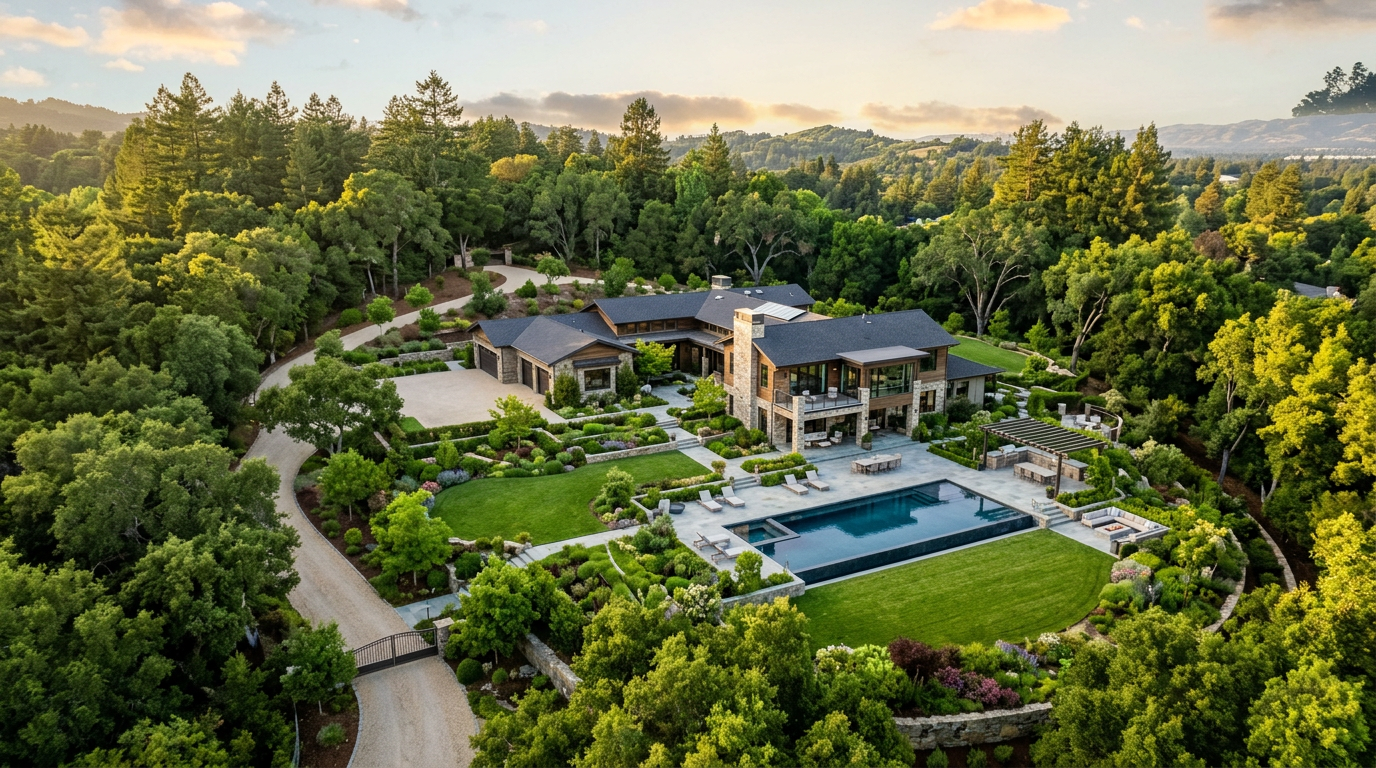
In Silicon Valley, it’s easy to be impressed by a home’s square footage.
Five bedrooms. Six bathrooms. A grand entry. A beautifully appointed kitchen.
But among discerning luxury buyers, another number can be just as compelling—sometimes more so.
The size, quality, and usability of the land beneath the home.
In communities such as Los Gatos, Saratoga, and Monte Sereno, where desirable residential parcels can be difficult to replicate, the property surrounding a home may be one of its most valuable attributes.
A beautifully designed house can be renovated, expanded, or even rebuilt. The location, dimensions, and natural characteristics of its land are far less easily changed.
So when might lot size matter more than square footage?
1. Land Offers Something Square Footage Cannot: Scarcity
A home can be remodeled. A kitchen can be redesigned. Finishes can be replaced.
But creating additional land in an established neighborhood is rarely an option.
This is particularly relevant in Silicon Valley, where development patterns, geography, zoning, and the limited availability of certain residential parcels can constrain supply.
A property with a generous, usable lot may offer opportunities that a larger house on a smaller parcel cannot.
Scarcity alone doesn’t guarantee value, but desirable land characteristics can be difficult to duplicate.
That’s one reason sophisticated buyers often evaluate the parcel before becoming distracted by the house.
2. Privacy Has Become an Important Luxury Feature
Luxury isn’t always about having more space inside.
Sometimes it’s about having more distance outside.
A larger parcel may provide separation from neighboring homes, room for mature landscaping, or a more secluded outdoor environment.
In communities such as Monte Sereno and the hillside neighborhoods of Los Gatos and Saratoga, privacy can be an important part of a property’s appeal.
But lot size alone doesn’t guarantee privacy.
A thoughtfully landscaped half-acre may feel more secluded than a much larger property with limited screening or challenging topography.
The quality of the setting matters as much as the acreage.
3. Outdoor Living Expands the Experience of Home
California’s climate makes outdoor living a meaningful part of residential design.
A generous lot may accommodate outdoor dining, gardens, a swimming pool, entertaining terraces, recreational areas, or simply open space.
For some buyers, these features contribute more to everyday enjoyment than an additional bedroom or oversized formal living room.
The most compelling properties often establish a natural relationship between indoor and outdoor spaces.
A home with 3,000 square feet of thoughtfully designed living space and an exceptional garden may offer a more appealing experience than a 5,000-square-foot house occupying nearly its entire lot.
Luxury is about how a property lives—not simply how large the house is.
4. A Larger Lot May Offer Greater Flexibility
One reason buyers are attracted to larger parcels is the possibility of adapting the property over time.
Depending on applicable regulations, site conditions, and approvals, a parcel may offer opportunities for additions, accessory dwelling units (ADUs), pools, or other improvements.
California law has expanded opportunities for ADUs, but that doesn’t mean every lot can accommodate every proposed project.
Setbacks, easements, utility infrastructure, fire-safety requirements, environmental restrictions, and local development standards may affect what is feasible.
Never assume that a large lot automatically means substantial development potential.
Buyers should verify permitted uses and feasibility with the appropriate local planning and building departments and qualified professionals.
5. Not All Acreage Is Created Equal
This is where evaluating luxury land becomes more nuanced.
Imagine two properties, each situated on approximately one acre.
One offers a relatively level parcel with attractive landscaping, convenient access, and expansive usable outdoor space.
The other has steep slopes, limited access, significant easements, or areas subject to development restrictions.
Both may advertise the same acreage.
But their utility, maintenance requirements, development possibilities, and market appeal may be very different.
Buyers should investigate topography, drainage, access, boundaries, easements, utilities, and applicable land-use restrictions.
Usable land—not simply total land—is often the more meaningful measure.
6. The Relationship Between House and Lot Matters
An impressive house can lose some of its appeal when it feels oversized for its parcel.
Conversely, a smaller home positioned thoughtfully on a generous lot may feel more elegant, private, and connected to its surroundings.
Good site planning considers the home’s orientation, sunlight, views, outdoor circulation, landscaping, and relationship to neighboring properties.
The result can be a property that feels harmonious rather than crowded.
For buyers who appreciate architecture and design, that relationship can be more compelling than raw square footage.
7. Land Can Influence Long-Term Desirability
Home finishes change. Architectural trends evolve. Mechanical systems age.
But a property’s location and fundamental site characteristics generally remain.
That can make desirable land an important consideration for buyers thinking beyond the immediate transaction.
However, larger lots also carry responsibilities.
Landscaping, irrigation, tree maintenance, drainage, fencing, and other property expenses can be substantial. Hillside parcels may require additional attention to access, erosion, or geotechnical conditions.
And in California, wildfire exposure and insurance availability deserve careful investigation for certain properties.
The right parcel should fit both the buyer’s aspirations and their willingness to maintain it.
8. How Should Sellers Market a Property With Exceptional Land?
When a property has a particularly desirable parcel, the marketing shouldn’t focus exclusively on interior finishes.
A beautiful kitchen may attract attention, but the land may be the feature that truly distinguishes the home.
Professional photography, aerial imagery where appropriate, landscape-focused visuals, and thoughtful property descriptions can help communicate the setting.
Marketing should highlight verified attributes such as lot dimensions, privacy features, outdoor amenities, and the relationship between the residence and its surroundings.
Potential uses or development opportunities should never be presented as guaranteed without appropriate verification.
For the right property, the grounds deserve as much attention as the architecture.
The Bottom Line
In Silicon Valley luxury real estate, more square footage doesn’t always mean more luxury.
A smaller, beautifully designed home on an exceptional parcel may offer qualities that a much larger residence cannot easily replicate.
Privacy. Outdoor living. Natural beauty. Architectural harmony. Flexibility. Scarcity.
These are characteristics that can make land especially desirable.
The real luxury isn’t necessarily owning the biggest house. It’s owning a property where the land and the home work beautifully together.
Buying or Selling a Property With Exceptional Land?
I’m Margaret Shendal, Broker Associate with The Agency (DRE #01464329).
With a background in interior design and experience in luxury real estate, I bring an appreciation for architecture, landscape, and thoughtful property positioning to the buying and selling process.
I work with homeowners and buyers throughout Los Gatos, Saratoga, Monte Sereno, Campbell, San Jose, and Santa Clara County.
If you’re considering buying or selling a distinctive Silicon Valley property, contact me for a confidential consultation about its market positioning, value, and potential.
Compliance Disclaimer
This article is provided for general informational and educational purposes only and does not constitute legal, tax, financial, appraisal, engineering, insurance, or land-use advice. Lot dimensions, usable acreage, development potential, zoning requirements, environmental conditions, property values, and market preferences vary. Buyers and sellers should independently verify property information and consult qualified real estate, planning, building, legal, engineering, insurance, and other professionals regarding their specific circumstances.
Leave a Reply